

Language development in children: milestones, tips and warning signs
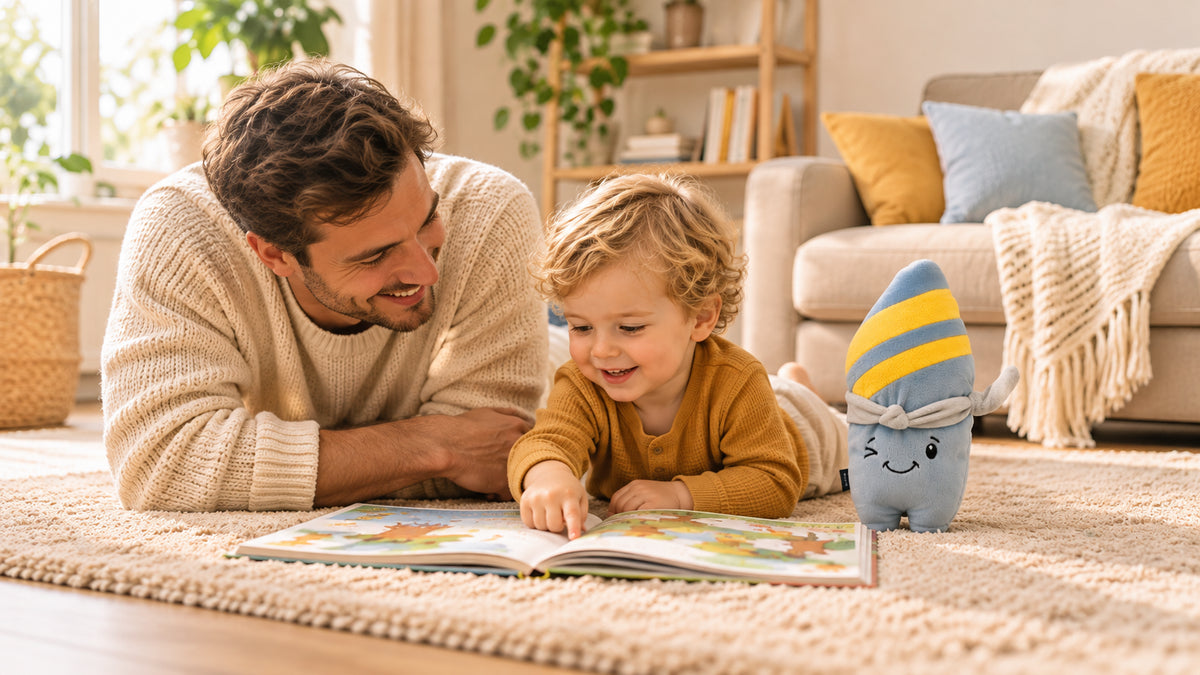
The short answer: most children say their first words between their first birthday and about one and a half years. In the second year of life, the first two-word sentences such as “Mummy play” follow, at three many children already talk about what they have experienced, and by the time they start school their language development is largely complete. The pace varies a lot: some children say their first word at nine months, a few only at around two and a half years.
Here you will find a chart with the most important milestones from 0 to 6 years, the warning signs worth raising with your paediatrician, and lots of ideas and games to support your child’s language in everyday life.
At a glance
- Language starts with listening: even newborns are more interested in voices than in any other sound.
- First words usually come between 12 and 18 months. At 20 months, children say roughly 50 to 200 words, and the range is wide.
- If your child says fewer than 50 words or no two-word sentences at the age of two, have this checked by a doctor. A good half of these children catch up on their own by school age.
- Everyday conversation helps most: listening, answering, naming things, reading aloud, singing. Rather than correcting mistakes, it is best to repeat what your child said in the correct form, in passing.
- A television on in the background slows down conversation. Audio stories can add to it, but they do not replace interaction.
- Growing up with several languages does no harm: children learn several languages in the same steps, and at first their vocabulary in each language may be smaller.
Language development by age: chart from 0 to 6 years
In most children, the steps of language development happen in the same order. When a child takes each step, however, varies greatly. The chart shows what many children can do at what age and how you can support your child. It is a rough guide, not a checklist your child has to tick off.
| Age | What many children can do | How to support your child |
|---|---|---|
| 0 to 3 months | Loves listening to voices and calms down at the sound of your voice, even without seeing you. From about two months, coos, laughs out loud and turns towards sounds. | Talk and sing to your baby a lot, imitate their sounds and give them time to “answer”. |
| 3 to 6 months | Squeals, hums and shrieks with delight, babbles vowels like “a” and “i”. Can tell a friendly tone of voice from an angry one. At five or six months, strings the first syllables together: “da-da-da”. | Respond to their sounds as you would in a conversation, use finger rhymes and knee-bouncing rhymes, describe everyday life in short sentences. |
| 6 to 12 months | Babbles strings of syllables and adapts their sounds more and more to the language they hear. From about eight months, understands first words, towards the end of the first year often already 50 to 100, and simple requests such as “Give me the ball!”. Waves goodbye. | Name what your child is looking at, and look at picture books together regularly. |
| 12 to 18 months | Most children say their first words, often “mama” and “dada” or words like “yum-yum” for food. One word stands for a whole sentence. Your child understands much more than they can say. | Pick up words and expand them: if your child says “ball”, answer “Yes, the red ball is rolling.” |
| 18 to 24 months | Vocabulary grows steadily, and at 20 months it is around 50 to 200 words. First two-word sentences such as “Mummy play”, then sentences with three words such as “Me want ball”. Knows and says their own name. Sounds such as cl, gr or sp often do not work yet. | Ask open questions, sing songs with actions, let your child point to things in picture books. |
| 2 to 3 years | Links sentences with “and” or “and then”, and simple sentences are grammatically correct (“I’m hungry”). Asks “How?” and “Why?”, sings along to children’s songs and rhymes. | Answer questions patiently and add an explanation, play role-play games, complete rhymes together. |
| 3 to 4 years | Talks about what they have experienced and what they are planning. Forms subordinate clauses with “if”, “because” or “when” and masters almost all sounds; only hissing sounds such as s, z or sh often still cause trouble. Some children stutter for a while because they are so eager to tell you things. | Ask questions when your child tells you about nursery, spin stories further together, do not put on pressure. |
| 4 to 6 years | Language development is on the home straight: by the time they start school, children actively use over 3,000 words, form main and subordinate clauses and put more abstract thoughts into words. Grammar and hissing sounds become more secure. | Read aloud, including longer stories, play rhyme and syllable games, make up stories together. |
Guide values based on kindergesundheit-info.de (BIÖG). Every child develops at their own pace.
Good to know: Children almost always understand more than they say. Towards the end of the first year, many already understand 50 to 100 words but say only a few or none themselves. So do not only pay attention to how many words your child says, but also to whether they understand you, for example when you ask them to bring you something.
The stages of language development
Roughly speaking, language development can be divided into stages: from crying, cooing and babbling to first words and two-word sentences, and on to telling whole stories. The transitions are fluid, and understanding, pronunciation, vocabulary and sentence structure do not always develop at the same pace.
The first year: crying, cooing, babbling
Long before their first word, your baby communicates with you. In the first months, crying is their strongest means of expression, along with eye contact, facial expressions and body language. When you respond, comfort them, talk to them or hand them the toy they are looking at, they learn that communication works and is fun. This back and forth is the engine of language development.
Your baby already knows your voice from the womb, where they became familiar with the sound and melody of their mother’s voice. Our guide to hearing in the womb shows what babies hear before birth.
Over time, cooing turns into babbling with syllables like “ba-ba” or “da-da”. Your baby listens to themselves and adapts their sounds more and more to the language they hear around them. These are not deliberate words yet, but they are important early steps towards speaking.
First words: one word stands for a whole sentence
Between their first birthday and about one and a half years, most children say their first words. A single word often means much more: “ball” can mean “I want the ball”, “Let’s play” or “The ball has gone”. At the same time, your child already understands far more than they can say, for example simple requests or questions such as “Where’s Daddy?”.
Language development at 2 years: from words to sentences
During the second year of life, vocabulary grows and your child starts to combine words. Two-word sentences such as “Mummy play” or “Daddy ball” are followed by sentences with three words such as “Me want ball”. At 20 months, children say roughly 50 to 200 words, so the differences are large.
After the second birthday, things move quickly: your child links sentences with “and” or “and then”, simple sentences are already grammatically correct, and they no longer just ask “What?” but also “How?” and “Why?”. They sing along to children’s songs and rhymes. Mistakes are part of it: when your child says “I goed”, they are applying a grammar rule, just also where it does not fit.
Tip: You do not need to correct these mistakes. Simply repeat the sentence correctly in passing: “Yes, you went out with Daddy today.” That way, your child hears the correct form without the conversation turning into an exercise.
Language development at 3 years: telling, asking, explaining
At three, many children want to tell you what they have experienced and what they are planning. They talk about yesterday and tomorrow and more and more often form subordinate clauses with “if”, “because” or “when”. Almost all the sounds of their native language now work; only hissing sounds like s, z or sh often need a little more time.
Because they are so eager to tell you things, some children falter and repeat syllables or words. This kind of stuttering is common: about five per cent of children stutter from time to time between the ages of two and five, and in most of them it goes away on its own. It is best not to comment on it, to give your child time and then simply carry on talking normally. If the stuttering persists, talk to your paediatrician.
4 to 6 years: almost like the grown-ups
At four to five years, language development is on the home straight. By the time they start school, children use over 3,000 words, form main and subordinate clauses and can put more abstract thoughts into words. Tenses, plurals and hissing sounds become more secure.
At this age, children also discover that words can sound alike, like “house” and “mouse”, and that they can be broken down into syllables. This feel for sounds and rhymes is one of the foundations that later help with learning to read and write. If you notice strikingly unclear pronunciation, have your child’s hearing checked as well: it can be a sign of a hearing disorder.
Delayed language development: when to see a paediatrician?
Because children learn to speak at such different speeds, it is often hard for parents to judge whether everything is right for their child’s age. An important point of reference is the second birthday: if a child says fewer than 50 words by then or does not yet form two-word sentences, there may be a delay in language development. If there is no identifiable physical or cognitive cause, experts call these children “late talkers”.
A good half of late talkers catch up on their own between their third year of life and school age. If, on the other hand, a child shows hardly any signs of catching up in the third year of life, experts speak of a language development disorder, which should be assessed and treated by specialists. Because it is impossible to say in advance which group a child belongs to, an early look is worthwhile: the earlier a delay or disorder is recognised, the better a child can be supported.
Raise it with your paediatrician if you notice any of the following:
- In the first year: Your baby hardly reacts to noises or to your voice, or babbles strikingly little after the first six months.
- At two years: Your child says fewer than 50 words or no two-word sentences like “Daddy ball” yet, or hardly understands simple requests.
- From the third year of life: Difficulties persist, such as very unclear pronunciation, a vocabulary that hardly grows, many placeholders like “thingy” or “do” instead of precise words, or sentence errors like “Mummy shop go”.
- At any age: Your child loses skills they already had, stutters over a longer period, or you doubt that they hear well.
Important: Mention your observations at the next routine check-up at the latest, or sooner if you are very worried. Only a hearing test by a doctor can say for sure whether a child hears well, even if the newborn hearing screening was normal.
In Germany, at the U7 check-up at 21 to 24 months, the doctor checks whether your child understands simple words and sentences and advises you on how to support their language. At the U7a check-up at 34 to 36 months, language development receives particular attention. If anything stands out, the next steps may be a hearing test, a specialist in speech, voice and childhood hearing disorders (phoniatrics and paediatric audiology) and speech and language therapy.
Good to know: Not every mistake is a warning sign. It can take until the fourth year of life for lips, tongue and larynx to work together reliably. Typical while learning to speak are left-out sounds (“poon” instead of “spoon”), shortened words (“nana” instead of “banana”) or sounds in the wrong order (“pasghetti” instead of “spaghetti”).
Supporting language development: 8 ideas for everyday life
Learning to speak cannot be sped up, because children acquire language on their own initiative. Nevertheless, you have a great deal of influence, because children only learn language through interaction: they need someone who understands them, answers them and models language for them. These eight ideas need no materials and fit into any family’s everyday life.
1. Put everyday life into words
From the very beginning, tell your baby in short, simple sentences what you are doing: “Now I’m putting your nappy on.” “Daddy’s picking you up.” It is best to name what your child can see, hear or feel at that moment and to pick up on what interests them: “That’s a ball.” Many parents quite naturally speak more slowly and clearly while doing this, with lots of repetition, and that is exactly what helps babies listen.
At first, you are welcome to imitate baby talk, as this reassures your baby. Once your child is a toddler, it is better to speak in simple but correct sentences.
2. Conversations instead of explanations
Whether you are shopping, cooking or out for a walk, everyday life offers plenty of opportunities for conversation. Involve your child. Instead of telling them that you are buying apples now, ask: “Which apples shall we get, the red ones or the green ones?” Pick up on what your child says and expand on it: if they say “Big dog”, answer “Yes, the big dog is running across the field.” That way, they learn new words and sentence patterns without the conversation feeling like an exercise.
Good to know: A US long-term study with 146 children shows how important this back and forth is. In the 44 children whose everyday life was recorded at 18 to 24 months, the number of conversational turns with adults was linked to vocabulary, language comprehension and IQ about ten years later, even when the families’ social background was taken into account. The mere number of words adults spoke was much more weakly linked to these outcomes once social background was taken into account (Gilkerson et al., 2018). This is a correlation, not proof of cause and effect, but it suggests that conversation is what matters most.
3. Discover picture books together
Even in the first year, it is worth looking at picture books together: “Who’s that? What does the cow say?” Later, books introduce your child to words and situations that come up less often in everyday life. Dialogic reading is particularly valuable: you do not just read aloud, you also talk with your child about what is happening in the pictures.
- “What can you see in the picture?” encourages your child to name objects and characters.
- “What is the little fox doing?” invites them to describe actions.
- “What do you think happens next?” encourages them to put their own guesses into words.
- “How do you think the character feels?” connects language with recognising feelings.
Younger children in particular like to look at individual pictures for longer or at the same page several times. Give your child room to do so. Reading aloud then becomes a shared discovery in which your child becomes the storyteller.
4. Tell stories, read aloud, listen
The younger your child, the better freely told stories work: if their attention wanders, make the story more exciting, and if it gets too exciting, take your child in your arms and resolve it. Later, reading aloud and audio stories are added. When listening, children get to know new words, sentence patterns and ways of telling a story, and they practise following a plot.
It is especially nice when a story lives on after listening: which character did your child like? How could the adventure continue? Our guide to audio plays for children shows from what age audio plays are suitable and how long they should play.
5. Role play and imaginative stories
When a cuddly toy suddenly starts talking or a blanket turns into a pirate ship, there are lots of opportunities to use language. Children make up dialogues, describe situations and slip into roles. In doing so, they do not just name things, they also plan actions and express feelings.
Support your child with open questions: “Where would your cuddly toy like to travel today?” or “What does it need for its adventure?” It is best when your child decides the story and you simply play along. You can read how to strengthen your child’s imagination in our guide to fostering imagination in children, and how children learn to put feelings into words in our guide to children’s emotions.
6. Songs, rhymes and finger rhymes
Language is made up not just of words, but also of rhythm, stress and sounds. Songs, rhymes and finger rhymes work on exactly that and give even babies great pleasure. The more often you repeat them, the better: many children want to hear the same song again and again and gradually join in.
Tip: You do not need elaborate activities. A children’s song while tidying up, a finger rhyme while changing a nappy or a made-up nonsense rhyme is often enough.
7. Give your child time to answer
In everyday family life, things sometimes have to move quickly. It is easy for adults to answer questions themselves or to finish their children’s sentences. Yet putting things into words themselves is an important part of learning to speak. When your child is searching for a word, wait a moment and always let them finish. Open questions help: instead of “Did you have a nice time at nursery?”, ask “What did you play at nursery today?”
Do not interrupt your child when they talk to themselves while playing, either. For children, speaking is thinking out loud.
8. Take questions seriously
At around two, the why questions begin, often without a break. Your child is not trying to get on your nerves but really wants to find something out. Answer their questions patiently and feel free to add an explanation: if your child says “There’s a yellow car”, you can answer: “That’s the post van. It brings letters and parcels.” If your child is tired or not in the mood, you do not need to explain anything.
Games that support language development
For children, play is the most natural way to practise language. Games in which your child gets to speak themselves work best. A few ideas by age:
For babies
- Sound games: Imitate your baby’s sounds and vary them. Your baby watches your mouth and “answers” with new sounds.
- Knee-bouncing and finger rhymes: Rhymes with movement combine rhythm, language and closeness.
- Peekaboo with words: “Where’s teddy? There he is!” turns words into a game.
- Animal sounds: “What does the cow say?” Pointing at animals in a picture book and imitating their sounds delights even the youngest.
For children aged 1 to 3
- Point and name: “Where’s your nose?” “Show me the dog!” Later, your child names things themselves.
- Action songs: Songs where you clap, stamp or turn around link words with movements.
- Guess the sound: Doorbell, tap or birdsong: what can you hear?
- Play shop and toy kitchen: Simple role play with set phrases such as “I’d like an apple, please.” “Here you are.”
- Finish the rhyme: You start a familiar rhyme and your child says the last word.
For children aged 3 to 6
- I spy with my little eye: Describing and guessing expands vocabulary and sharpens observation.
- Clapping syllables: “ba-na-na” in three claps, “el-e-phant” too.
- Finding rhymes: What rhymes with “mouse”? Nonsense words are explicitly allowed.
- Spinning stories: One person starts, and the next adds a sentence.
- Cuddly toy theatre: Cuddly toys or hand puppets get their own voices and go on an adventure.
- Whisper game: A classic for children’s birthday parties, for older children who can already listen carefully.
Tip: Only play for as long as your child enjoys it. Language games should be fun, not a test of what your child can already do.
What can hold back language development
Children learn language on their own initiative. But things that get in the way of hearing or conversation can slow them down:
- Hearing problems: A child who cannot hear well cannot learn to speak well either. Newborn hearing screening looks for congenital hearing disorders. Later on, new problems can arise, for example from middle ear infections. If a child can already talk, these problems sometimes go unnoticed for a long time.
- A television on in the background: In a US study with 329 children aged 2 to 48 months, every hour of audible television went along with fewer words from adults, fewer vocalisations from the children and fewer conversational turns (Christakis et al., 2009). In a laboratory experiment with 51 children aged one to three, the amount and quality of interaction between parent and child decreased as soon as a programme for adults was on in the background (Kirkorian et al., 2009).
- Screens instead of play: The World Health Organization advises against screen time for children under two and recommends reading and storytelling with a caregiver for quiet times. kindergesundheit-info.de advises avoiding screen media altogether for children under three if possible. You can find ideas for games without screens in our guide to screen-free play.
- Pressure and constant correcting: Having to repeat words again and again or being laughed at for unusual words can easily take away children’s joy in speaking. It is better to pick up mistakes casually in the correct form.
- Ignoring gestures: Facial expressions and gestures are part of communication. If you deliberately do not react to them so that your child speaks “properly”, you put them under pressure.
- Constant comparisons: Every child has their own pace. Comparisons with siblings or other children at nursery tend to unsettle rather than help. If you are genuinely worried, your paediatrician is the right place to go.
Why listening is so important
Before children use words themselves, they often need to have heard them. But when listening, they learn more than individual words: how the voice rises with a question, how joy or anger sounds and how words in a sentence belong together. Later, they learn to follow longer stories and to remember which characters appear and what has already happened.
Listening in conversation is the most valuable kind, because your child can answer. Reading aloud combines language with pictures and offers many occasions to talk about a story. Audio stories bring tales to life with voices, sounds and music. According to the German parenting portal kindergesundheit-info.de, listening to an audio play repeatedly can have a positive effect on language development, especially on vocabulary. However, audio media should not become permanent background noise.
Good to know: As a guide, kindergesundheit-info.de names no more than 30 minutes a day of audio media such as music and audio stories for children under 3, no more than 45 minutes for children aged 3 to 6 and no more than 60 minutes for children aged 6 to 9. Looking at picture books and reading aloud, on the other hand, are fine regularly, from about six months.
Lenabo: listening to stories and retelling them
A Lenabie is a soft cuddly toy with its own character, its own voice and its own stories. As soon as the Lenabo Smart Speaker is placed inside the cuddly toy, it recognises the character and plays the matching content, such as bedtime stories, audio plays and learning content, selected by age. The familiar cuddly toy stays, and the content grows with your child.
For language, what matters most is what happens after listening. Ask your child what the character experienced, let them act out the story with the Lenabie or make up a new adventure together. Without the speaker, the Lenabie is a fully fledged cuddly toy that can join in any role play. You can see which stories and learning content are available in the overview of digital content, and find out more about the characters in our article on what a Lenabie is.
To be honest: A Lenabie does not replace a conversation with you. There is no evidence that children learn to speak earlier or better with an audio system. Audio stories complement conversations, reading aloud and play. Stick to the guide values for audio media and do not let stories play constantly in the background.
Price: The Starter Kit with smart speaker and a Lenabie costs €99.99 at the regular price. Each additional Lenabie costs €39.99, with cuddly toy, its own voice and 90 minutes of content. One speaker is enough for all Lenabies, including those of siblings. You can find current offers in the shop.
View Starter Kits · All audio content
Growing up multilingual: what parents should know
Many children grow up with two or more languages. This is not a disadvantage but an opportunity: they will never learn additional languages as easily as in their first years of life. Children can learn several languages at the same time or one after the other, and they go through the same developmental steps as monolingual children.
Especially when a child learns two languages at the same time, development may be somewhat delayed at first: vocabulary in each individual language is sometimes smaller until early school age, sentences are simpler, and many children mix the languages for a while. This is normal and usually sorts itself out.
- Speak your language: Talk to your child in the language in which you feel most confident and can best express feelings. This is usually your own native language.
- Clear patterns: It helps if your child can associate a language with a particular person or situation, rather than the languages switching at random.
- Value both languages: Keep answering in your language even if your child speaks only the language of your surroundings for a while.
- Nursery as a place for language: If the language of your surroundings is not spoken at home, your child will learn it mainly by playing with other children and from the staff at nursery. Our guide to settling in at nursery shows how to get off to a good start there.
As with monolingual children, persistent language problems can also occur in multilingual children. If you are unsure whether your child is developing as expected for their age in their first language or in both languages, talk to your paediatrician.
Conclusion: language grows through conversation
Language development begins long before the first word and is only largely complete by the time a child starts school. In between lie big steps that every child takes at their own pace: babbling, first words, two-word sentences, why questions and finally whole stories. What helps your child most is not a learning programme, but someone who listens, answers, reads aloud and plays along. Keep an eye on the warning signs, raise any concerns with your paediatrician and otherwise do not let comparisons unsettle you. Sometimes the nicest conversation starts with a simple question: “What did you do today?”
Frequently asked questions
When do children say their first words?
Most children say their first words between their first birthday and about one and a half years, often “mama” and “dada”. Some start as early as nine months, while a few take until about two and a half years. Children understand a lot before that: towards the end of the first year, often 50 to 100 words.
How many words does a 2-year-old say?
The range is wide. At 20 months, the active vocabulary of typically developing children is between about 50 and 200 words. If a child says fewer than 50 words or no two-word sentences at two, raise it with your paediatrician.
What language development is normal at 2 years?
At around two, many children speak in two- and three-word sentences such as “Mummy play” or “Me want ball”, say their own name and understand simple requests. During the third year of life, sentences become longer and more grammatically correct, and the why questions begin. Sounds such as cl, gr or sp and hissing sounds may still be missing.
What should a 3-year-old be able to say?
At three, many children talk about things they have experienced and things they are planning, talk about yesterday and tomorrow and more and more often form subordinate clauses with “if” or “because”. Almost all sounds work, though hissing sounds like s, z or sh often not yet. Temporary stuttering out of sheer eagerness to talk is common at this age. In Germany, the paediatrician pays particular attention to language at the U7a check-up shortly before the third birthday.
When is language development considered delayed?
Experts speak of delayed language development if a child says fewer than 50 words or does not yet form two-word sentences at the age of two. A good half of these late talkers catch up on their own by school age. If a child hardly catches up in the third year of life, this is considered a language development disorder, which should be assessed and treated by specialists.
What hinders language development?
Above all, things that get in the way of hearing or conversation can slow it down: hearing problems, for example after middle ear infections, little interaction, a television that is constantly on in the background, and pressure from constant correcting or making children repeat words. More than anything, children need someone who listens to them and answers.
Which games support language development?
Games in which your child gets to speak themselves are good: finger rhymes and knee-bouncing rhymes for babies, pointing and naming, action songs and role play such as playing shop for toddlers, and from about three, rhymes, clapping syllables, “I spy” and stories you spin together. What matters is that the game is fun and does not turn into a test.
Do multilingual children start talking later?
Sometimes a little. Multilingual children go through the same developmental steps as monolingual children. If they learn two languages at the same time, development can be somewhat delayed at first: vocabulary in each language is smaller, sentences are simpler, and many children mix the languages for a while. This is normal and usually sorts itself out. If difficulties persist, have them checked by a doctor, as you would for any child.
Can audio plays support language development?
Audio plays can familiarise children with new words, sentence patterns and ways of telling a story. According to kindergesundheit-info.de, repeated listening in particular can have a positive effect on vocabulary. It is nice if you talk about the story afterwards. Audio plays do not replace conversation, and as a guide, no more than 30 minutes of audio media a day applies to children under 3 and no more than 45 minutes to children aged 3 to 6.
Sources and last updated
BIÖG, kindergesundheit-info.de: Basics of language development (as of 27 February 2026, in German). kindergesundheit-info.de
BIÖG, kindergesundheit-info.de: A baby’s first steps in language development (as of 26 April 2026, in German). kindergesundheit-info.de
BIÖG, kindergesundheit-info.de: Recognising difficulties in language development (as of 27 March 2026, in German). kindergesundheit-info.de
BIÖG, kindergesundheit-info.de: How to support your child’s language development (as of 18 July 2026, in German). kindergesundheit-info.de
BIÖG, kindergesundheit-info.de: Encouraging your baby’s joy in making sounds (as of 18 July 2026, in German). kindergesundheit-info.de
BIÖG, kindergesundheit-info.de: Reading aloud and storytelling, a treasure for development (as of 29 October 2025, in German). kindergesundheit-info.de
BIÖG, kindergesundheit-info.de: Children in multilingual families (as of 26 February 2026, in German). kindergesundheit-info.de
BIÖG, kindergesundheit-info.de: When your child grows up with several languages (as of 17 July 2026, in German). kindergesundheit-info.de
BIÖG, kindergesundheit-info.de: U7 check-up, 21st to 24th month of life (as of 26 August 2026, in German). kindergesundheit-info.de
BIÖG, kindergesundheit-info.de: U7a check-up, 34th to 36th month of life (as of 26 August 2026, in German). kindergesundheit-info.de
BIÖG, kindergesundheit-info.de: Detecting hearing disorders early (as of 1 March 2026, in German). kindergesundheit-info.de
BIÖG, kindergesundheit-info.de: How to tell whether your child hears well (as of 18 July 2026, in German). kindergesundheit-info.de
BIÖG, kindergesundheit-info.de: Audio media for children (as of 9 April 2024, in German). kindergesundheit-info.de
BIÖG, kindergesundheit-info.de: How often and for how long may children use media? (as of 2 December 2025, in German). kindergesundheit-info.de
Gilkerson, J., Richards, J. A., Warren, S. F., Oller, D. K., Russo, R. and Vohr, B. (2018): Language Experience in the Second Year of Life and Language Outcomes in Late Childhood. Pediatrics, 142(4), e20174276. pubmed.ncbi.nlm.nih.gov/30201624
Christakis, D. A. et al. (2009): Audible television and decreased adult words, infant vocalizations, and conversational turns: a population-based study. Archives of Pediatrics and Adolescent Medicine, 163(6), 554-558. pubmed.ncbi.nlm.nih.gov/19487612
Kirkorian, H. L., Pempek, T. A., Murphy, L. A., Schmidt, M. E. and Anderson, D. R. (2009): The impact of background television on parent-child interaction. Child Development, 80(5), 1350-1359. pubmed.ncbi.nlm.nih.gov/19765004
World Health Organization (WHO): To grow up healthy, children need to sit less and play more (24 April 2019). who.int
World Health Organization (WHO): Guidelines on physical activity, sedentary behaviour and sleep for children under 5 years of age (2019). who.int
This article does not replace medical advice. If you are worried about your child’s language development or hearing, please contact your paediatrician.
Last updated: November 2026
